DepthNet and SegNet on a Clearpath Husky
Two perception networks, one edge device, and the question that only hardware answers: does it hold up at the frame rate the robot actually needs?
What this was
DepthNet and SegNet deployed on an NVIDIA Jetson AGX Orin aboard a Clearpath Husky and tested in the lab environment. Monocular depth estimation and semantic segmentation running against a live camera feed while the robot drove.
Why bother, when the benchmarks already exist
Benchmark numbers are computed on curated frames. A robot sees motion blur, its own shadow, overexposed windows and geometry the training set never contained, at whatever rate the edge device can sustain while everything else is also running. Putting the networks on the vehicle is how you find out which of those actually degrades the output, and it’s the difference between a model that scores well and a perception stack you’d let drive something.
Credit
Group work in the ARM Lab led by Ameya Salvi and Harshal Varpe; I worked on the deployment and testing on the Husky.
More projects
See all →Current work
Simulation, Learning and Edge AI at Arrive AI
Digital twin simulation, reinforcement learning, vision-language-action models, and the edge inference stack that has to run modern models fast enough to be useful.
 ICRA 2025
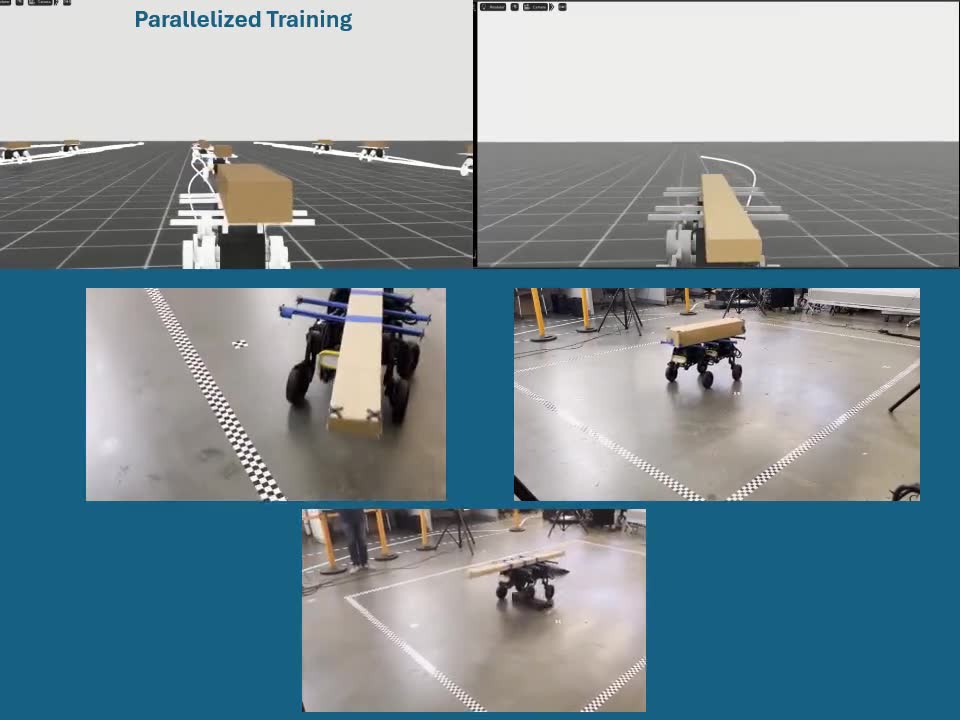
 Coordinated Payload Transport with Biped-Wheeled Robots
One reinforcement learning agent driving two balancing robots to carry a shared payload, trained in Isaac Lab and transferred to hardware with no fine-tuning.
 IEEE AIM 2024
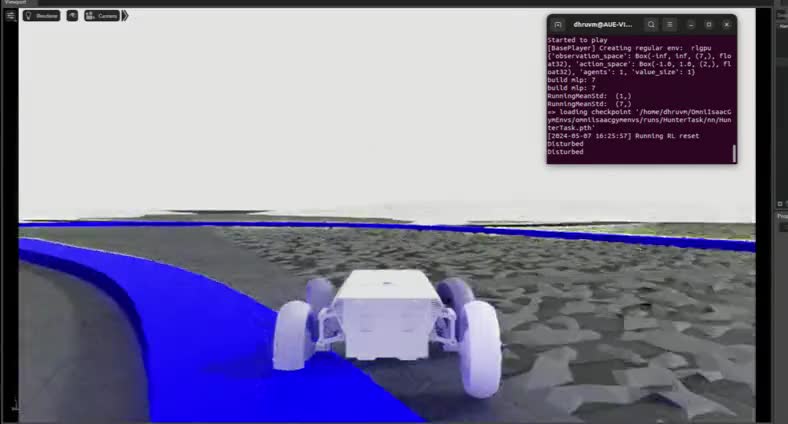
 Rough-Terrain Path Tracking with Hybrid Deep Reinforcement Learning
A model-based controller and a learned policy working together, so an Ackermann-steered vehicle tracks a path across terrain neither was tuned for.