ICRA 2025
Coordinated Payload Transport with Biped-Wheeled Robots
Two robots, one payload, and a single policy that has to keep both of them upright while the load couples their dynamics together.
The problem
Carrying something together is harder than carrying it alone. Two biped-wheeled robots holding one payload are no longer independent systems: every correction one makes shows up as a disturbance at the other, and both are balancing on two wheels while it happens. The usual answer is a controller per robot plus a coordination layer on top, which means three things to tune and three places for the assumptions to break.
What I built
A single deep reinforcement learning agent that observes both robots and outputs commands for both, so coordination is learned rather than imposed. Training runs in Isaac Lab with thousands of environments in parallel, which is what made the experiment loop tractable. The same study that used to take hours per iteration came down to minutes, so I could actually explore policy architectures instead of babysitting one run.
Most of the effort went into the parts that don’t demo well: comparing network architectures for training stability and sample efficiency, then system identification and domain randomization to make the simulator resemble the robots I actually had.
Getting it onto hardware
The trained policy was exported to ONNX and run inside a ROS stack, with an OptiTrack motion capture system providing pose feedback. It transferred zero-shot: the policy that ran on the robots is the policy that came out of simulation, with tracking error staying within a 0.5 m range across terrains.
That number is the one I care about. It says the simulator was honest enough about friction, actuation and payload coupling that the policy didn’t need the real world to teach it anything new.
Where it landed
Accepted at the 2025 IEEE International Conference on Robotics and Automation in Atlanta, robotics’ flagship venue, and published in the proceedings (pp. 14992-14998).
More projects
See all →Current work
Simulation, Learning and Edge AI at Arrive AI
Digital twin simulation, reinforcement learning, vision-language-action models, and the edge inference stack that has to run modern models fast enough to be useful.
 IEEE AIM 2024
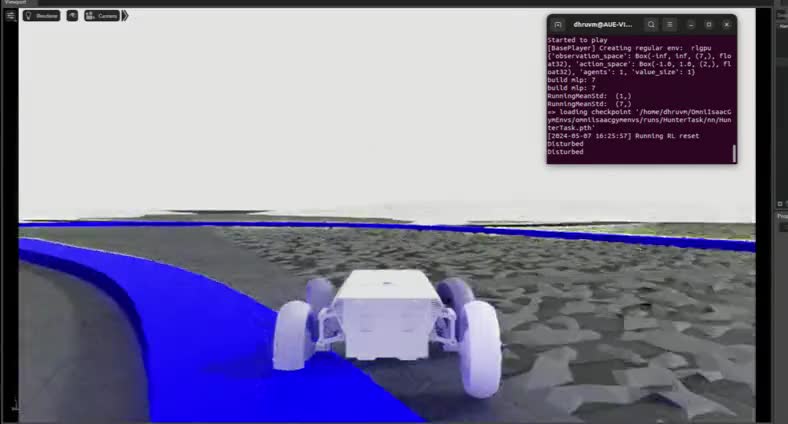
 Rough-Terrain Path Tracking with Hybrid Deep Reinforcement Learning
A model-based controller and a learned policy working together, so an Ackermann-steered vehicle tracks a path across terrain neither was tuned for.
 IFAC 2025
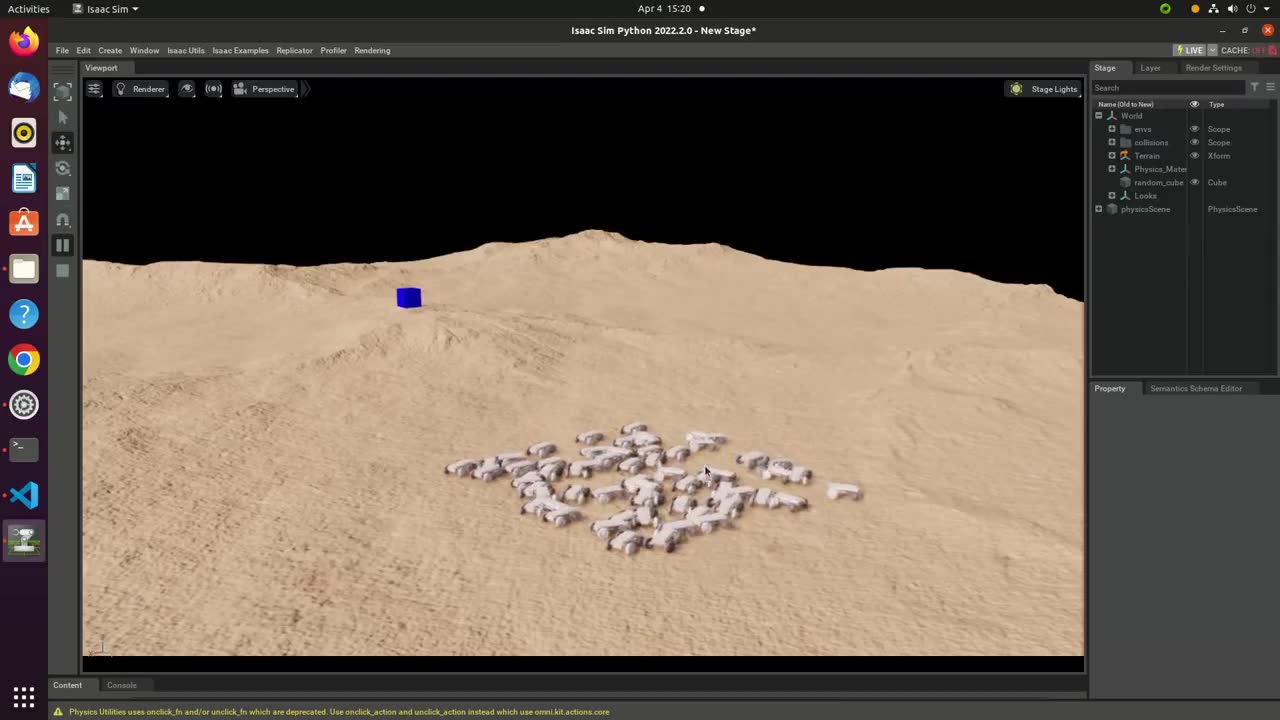
 Agile Off-Road Traversal of an Ackermann-Steered Platform
Goal-to-goal navigation learned end-to-end for a mid-scale off-road vehicle, with reward shaping tuned for stability rather than raw speed.