IFAC 2025
Agile Off-Road Traversal of an Ackermann-Steered Platform
Give the vehicle a goal pose in rough terrain and let it work out how to get there, without a hand-designed motion plan in the middle.
The problem
Point stabilization, meaning get to this position and this heading, is a well-understood problem on flat ground and a nuisance off it. An Ackermann-steered vehicle can’t turn in place, so the approach has to be planned; add slopes and loose surfaces and the plan stops matching what the vehicle can actually execute.
What I built
A learning-based goal-to-goal navigation policy that treats motion planning and control as one problem for a mid-scale off-road platform. The vehicle learns the approach behaviour directly rather than tracking a separately planned trajectory.
Reward shaping was the real work here. It’s easy to write a reward that produces a policy which reaches the goal by driving in a way no one would sign off on, so the shaping deliberately favoured stability over aggressive maneuvers, and I authored a custom off-road simulation environment so robustness was trained rather than assumed.
Result
An 86% success rate at reaching the desired goal across the evaluation set. Published in IFAC-PapersOnLine, Vol. 59(3), pp. 79-84.
More projects
See all →Current work
Simulation, Learning and Edge AI at Arrive AI
Digital twin simulation, reinforcement learning, vision-language-action models, and the edge inference stack that has to run modern models fast enough to be useful.
 ICRA 2025
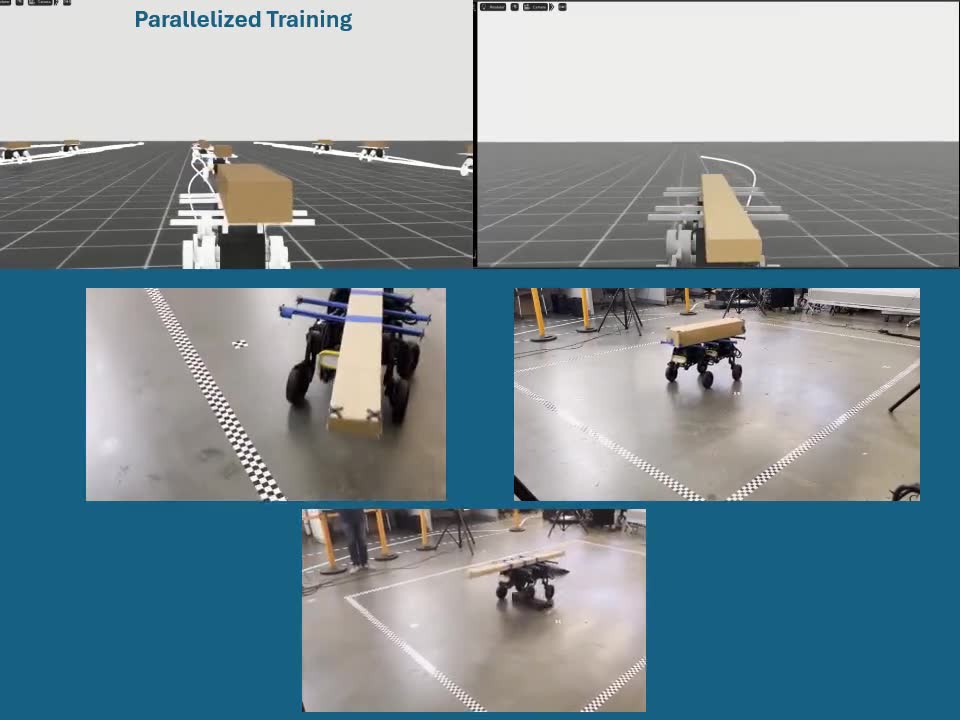
 Coordinated Payload Transport with Biped-Wheeled Robots
One reinforcement learning agent driving two balancing robots to carry a shared payload, trained in Isaac Lab and transferred to hardware with no fine-tuning.
 IEEE AIM 2024
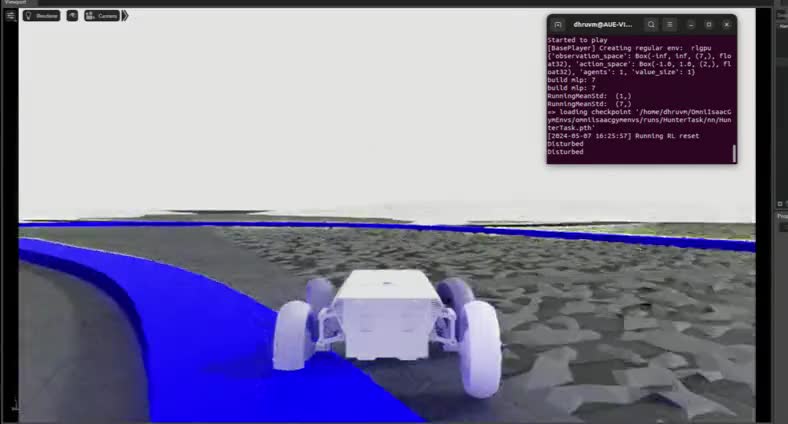
 Rough-Terrain Path Tracking with Hybrid Deep Reinforcement Learning
A model-based controller and a learned policy working together, so an Ackermann-steered vehicle tracks a path across terrain neither was tuned for.