IEEE AIM 2024
Rough-Terrain Path Tracking with Hybrid Deep Reinforcement Learning
Classical control is predictable but brittle on terrain it wasn't designed for. Learning is adaptable but hard to trust. This work puts them in the same loop.
The problem
A path-tracking controller tuned on flat ground gets into trouble the moment the ground stops cooperating. Slopes change the effective steering response, loose surfaces break the tire model, and the vehicle ends up cutting corners or oversteering. Retuning per surface doesn’t scale, and handing the whole job to a learned policy trades one problem for another: you lose the structure that made the classical controller predictable in the first place.
What I built
A hybrid framework: a model-based controller keeps its role as the stable backbone, and a deep reinforcement learning policy learns the corrections the model can’t express. The learned part handles what varies, whether that’s terrain, traction or geometry, while the model-based part keeps behaviour bounded and legible.
Choosing that split wasn’t obvious, so I evaluated policy architectures across several deep reinforcement learning frameworks rather than committing to one and hoping.
Building terrain worth training on
The policy is only as good as the ground it learned on, so the terrain wasn’t an afterthought. I authored the 3D rough-terrain assets in Blender and exported them through OpenUSD into the simulator, which meant I could define repeatable test protocols instead of eyeballing whether two runs were comparable.
The real-world test
The framework was validated on multiple unseen real-world tracks under that same repeatable protocol, reaching 98.5% precision in the real world. Below is one of those runs, with the vehicle tracking its path across an actual grass slope, not a rendered one.
Where it landed
Published at the 2024 IEEE International Conference on Advanced Intelligent Mechatronics (pp. 685–690). The work also became the core of my dissertation, Hybrid Learning for Rough Terrain Navigation of Actively Articulated Wheeled Vehicles.
More projects
See all →Current work
Simulation, Learning and Edge AI at Arrive AI
Digital twin simulation, reinforcement learning, vision-language-action models, and the edge inference stack that has to run modern models fast enough to be useful.
 ICRA 2025
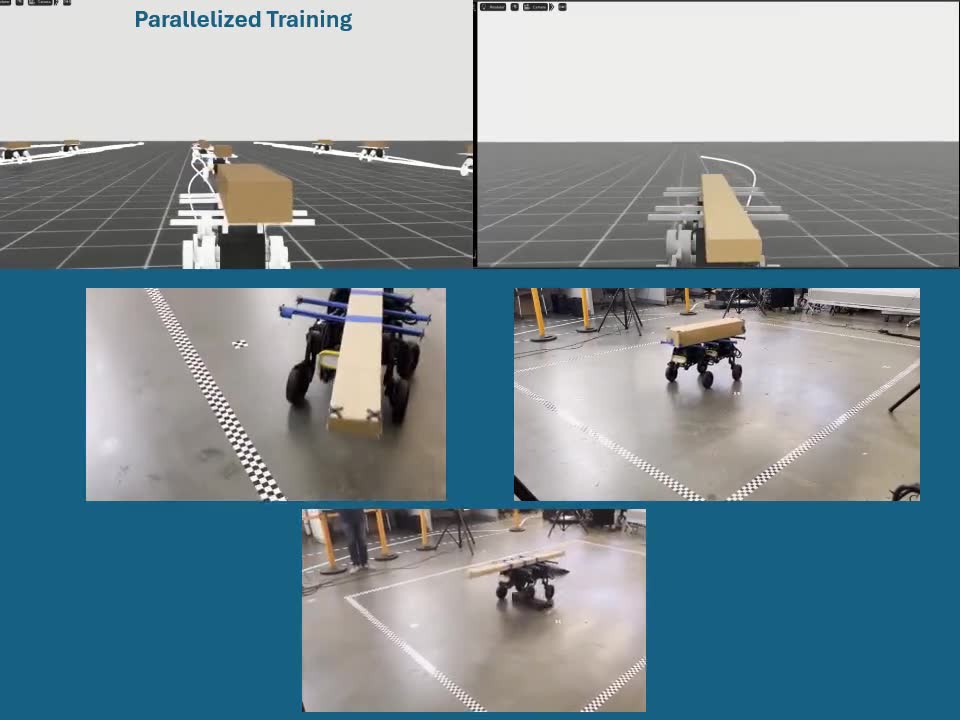
 Coordinated Payload Transport with Biped-Wheeled Robots
One reinforcement learning agent driving two balancing robots to carry a shared payload, trained in Isaac Lab and transferred to hardware with no fine-tuning.
 IFAC 2025
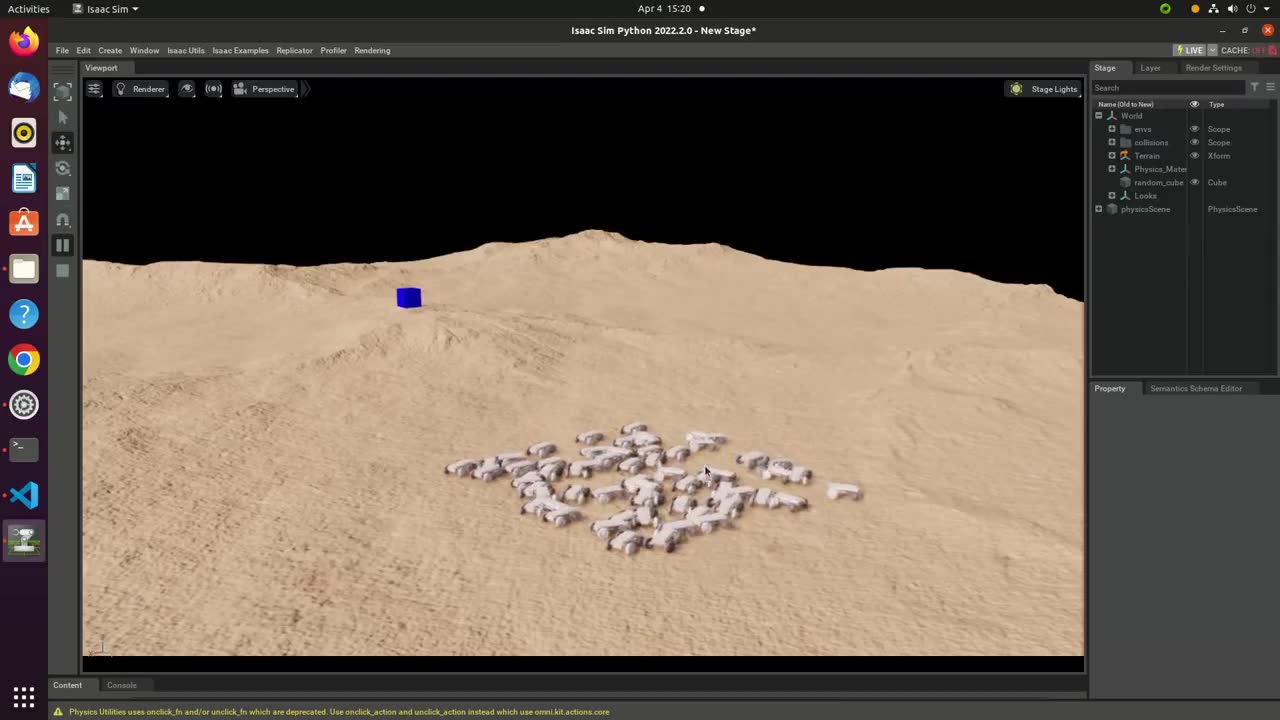
 Agile Off-Road Traversal of an Ackermann-Steered Platform
Goal-to-goal navigation learned end-to-end for a mid-scale off-road vehicle, with reward shaping tuned for stability rather than raw speed.