Kinematic Model Verification for a Unitree Go1
Every learned controller sits on top of a model of the robot. This is the unglamorous work of confirming that model matches the machine.
Why do this at all
Analytical formulations get written once and trusted forever. But a kinematic model is a claim about a physical object, and claims should be checked, especially when everything downstream, from state estimation to a learned locomotion policy, inherits whatever error it contains.
What I did
Derived a Denavit-Hartenberg parameter kinematic model for the Unitree Go1 quadruped, then verified it against data recorded from the actual hardware rather than against a second simulation. Agreement came out on the order of 10⁻², which was good enough to build on with confidence.
The write-up and the code are both linked above. It’s a small piece of work, but it’s the kind of verification step that quietly prevents a much more confusing debugging session later.
More projects
See all →Current work
Simulation, Learning and Edge AI at Arrive AI
Digital twin simulation, reinforcement learning, vision-language-action models, and the edge inference stack that has to run modern models fast enough to be useful.
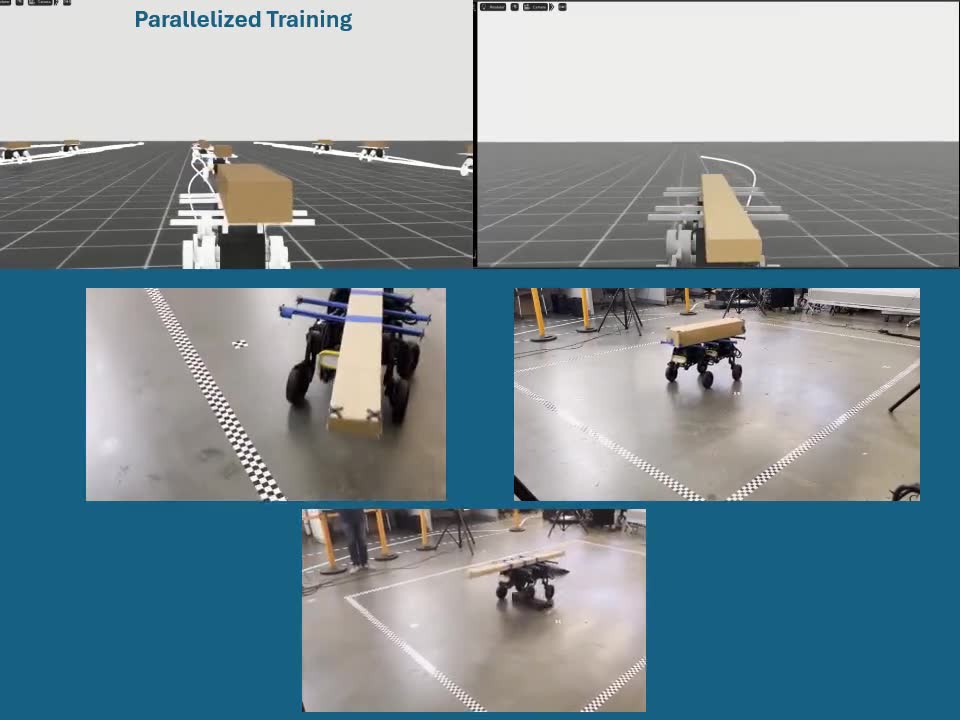 ICRA 2025
 Coordinated Payload Transport with Biped-Wheeled Robots
One reinforcement learning agent driving two balancing robots to carry a shared payload, trained in Isaac Lab and transferred to hardware with no fine-tuning.
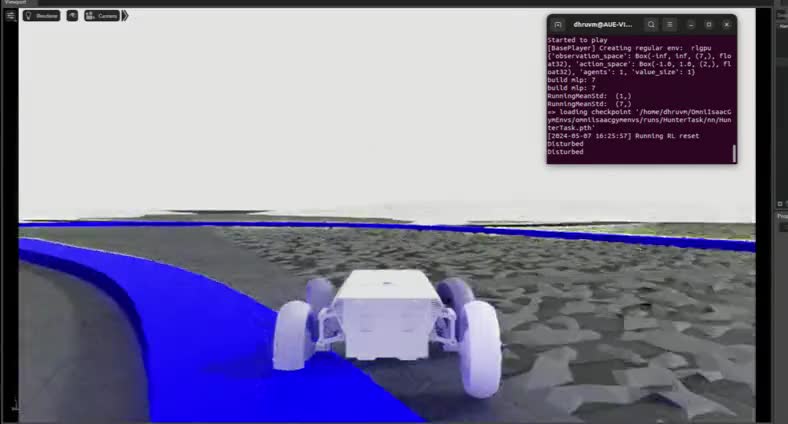 IEEE AIM 2024
 Rough-Terrain Path Tracking with Hybrid Deep Reinforcement Learning
A model-based controller and a learned policy working together, so an Ackermann-steered vehicle tracks a path across terrain neither was tuned for.